Prepare a surface for interpolated rendering on a texture triangle
Source:R/texture_surface.R
texture_surface.RdConstructs and validates a surface specification for use with the surface
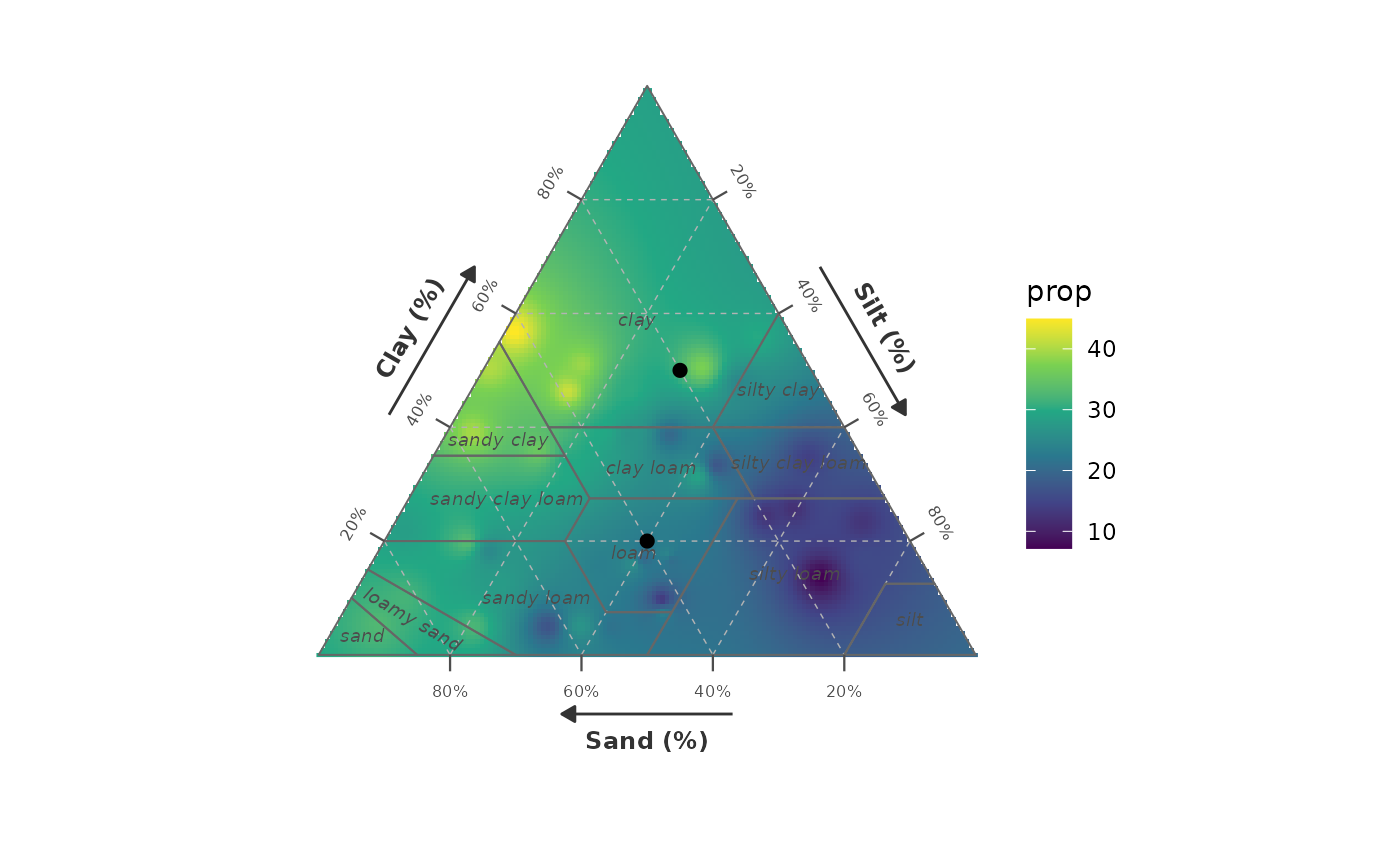
argument of gg_texture_triangle(). Resolves sand/silt/clay/z columns from
a data frame and stores the IDW interpolation settings. The actual grid
computation is deferred until plotting.
Arguments
- data
A data frame containing sample points with ternary coordinates and a numeric response variable.
- sand, silt, clay
Bare column names for the ternary coordinates (0–100).
- z
Bare column name for the numeric value to interpolate and display as a fill colour.
- resolution
Integer. Number of grid cells along the x-axis of the interpolation grid. Higher values give smoother surfaces at the cost of speed. Default
150L.- power
Positive numeric. IDW distance-decay exponent. Higher values give each data point more local influence. Default
2.
Value
An object of class "texture_surface" for use with
gg_texture_triangle().
Details
Interpolation is performed using Inverse Distance Weighting (IDW) in Cartesian space; no external packages are required.
Examples
# Generate synthetic data with a property that varies across texture space
set.seed(42)
surf_df <- data.frame(
  sand = runif(60, 5, 90),
  clay = runif(60, 5, 60)
) |>
  dplyr::mutate(silt = 100 - sand - clay) |>
  dplyr::filter(silt >= 0) |>
  dplyr::mutate(prop = sand * 0.3 + clay * 0.5 + rnorm(dplyr::n(), 0, 5))

pts <- data.frame(sand = c(40, 20), silt = c(40, 30), clay = c(20, 50))

gg_texture_triangle(pts, sand, silt, clay,
  surface = texture_surface(surf_df, sand, silt, clay, z = prop)) +
  ggplot2::scale_fill_viridis_c(name = "prop")