Overview
The Minidisk Infiltrometer (Decagon Devices) delivers water at a controlled tension (suction) below saturation. The Zhang (1997) method extracts the unsaturated hydraulic conductivity K(h) from a two-step analysis:
- Fit the Philip (1957) two-term polynomial to cumulative infiltration to recover the conductivity proxy C₁.
- Divide C₁ by the soil-specific shape parameter A (derived from Van Genuchten parameters and the applied tension) to get K(h).
minidisk_conductivity() wraps steps 2 in a single call,
giving a four-step pipeline from raw field readings to K(h):
| Step | Function |
|---|---|
| Raw readings → I(t) | infiltration_cumulative() |
| Philip two-term fit → C₁ | fit_infiltration() |
| VG lookup + K(h) = C₁ / A | minidisk_conductivity() |
The underlying functions infiltration_vg_params(),
parameter_A_zhang(), and
hydraulic_conductivity_minidisk() remain exported for cases
that need more control.
1. Single-site example
A typical Minidisk run records the reservoir volume (mL) at fixed time intervals. The disc radius is 2.25 cm (the standard instrument).
raw <- tibble(
  time   = seq(0, 300, 30),   # seconds
  volume = c(95, 89, 86, 83, 80, 77, 74, 73, 71, 69, 67)  # mL
)
The full pipeline from raw readings to K(h):
result <- raw |>
  infiltration_cumulative(time = time, volume = volume) |>
  fit_infiltration(.infiltration, .sqrt_time) |>
  minidisk_conductivity(texture = "sandy loam", suction = 2)

result |> select(.C1, .n, .alpha, .A, .K_h)
#> # A tibble: 1 × 5
#>       .C1    .n .alpha    .A     .K_h
#>     <dbl> <dbl>  <dbl> <dbl>    <dbl>
#> 1 0.00252  1.89  0.075  3.91 0.000645
K(h) ≈ 6.45^{-4} cm/s at 2 cm tension for this sandy loam sample.
2. Multi-site workflow
For field campaigns with multiple samples, group by site before
infiltration_cumulative(). Because grouping is now
preserved through cumulative calculations, only one
group_by() is needed for the whole pipeline.
multi <- tibble(
  site   = rep(c("A", "B"), each = 11),
  time   = rep(seq(0, 300, 30), 2),
  volume = c(
    95, 89, 86, 83, 80, 77, 74, 73, 71, 69, 67,   # site A — sandy loam
    95, 87, 81, 76, 72, 68, 65, 63, 61, 59, 58    # site B — loamy sand
  )
)

# Per-site metadata (texture, suction)
meta <- tibble(
  site    = c("A", "B"),
  texture = c("sandy loam", "loamy sand"),
  suction = c(2, 2)
)
multi_result <- multi |>
  group_by(site) |>
  infiltration_cumulative(time = time, volume = volume) |>
  fit_infiltration(.infiltration, .sqrt_time) |>
  left_join(meta, by = "site") |>
  minidisk_conductivity(texture = texture, suction = suction)

multi_result |> select(site, texture, .C1, .A, .K_h)
#> # A tibble: 2 × 5
#>   site  texture        .C1    .A     .K_h
#>   <chr> <chr>        <dbl> <dbl>    <dbl>
#> 1 A     sandy loam 0.00252  3.91 0.000645
#> 2 B     loamy sand 0.00137  2.43 0.000565
3. Analytical A with method = "zhang"
For non-standard disc radii or suction levels outside the Decagon
table, pass method = "zhang" to compute A analytically from
Zhang (1997) rather than looking it up. The radius argument
is only used in this mode.
multi |>
  group_by(site) |>
  infiltration_cumulative(time = time, volume = volume) |>
  fit_infiltration(.infiltration, .sqrt_time) |>
  left_join(meta, by = "site") |>
  minidisk_conductivity(texture = texture, suction = suction,
                        method = "zhang", radius = 2.25) |>
  select(site, texture, .A, .K_h)
#> # A tibble: 2 × 4
#>   site  texture       .A     .K_h
#>   <chr> <chr>      <dbl>    <dbl>
#> 1 A     sandy loam  3.82 0.000660
#> 2 B     loamy sand  4.21 0.000326
The analytical A values will differ slightly from the tabulated ones — both approaches are valid; the choice depends on whether your suction and radius match the Decagon reference conditions.
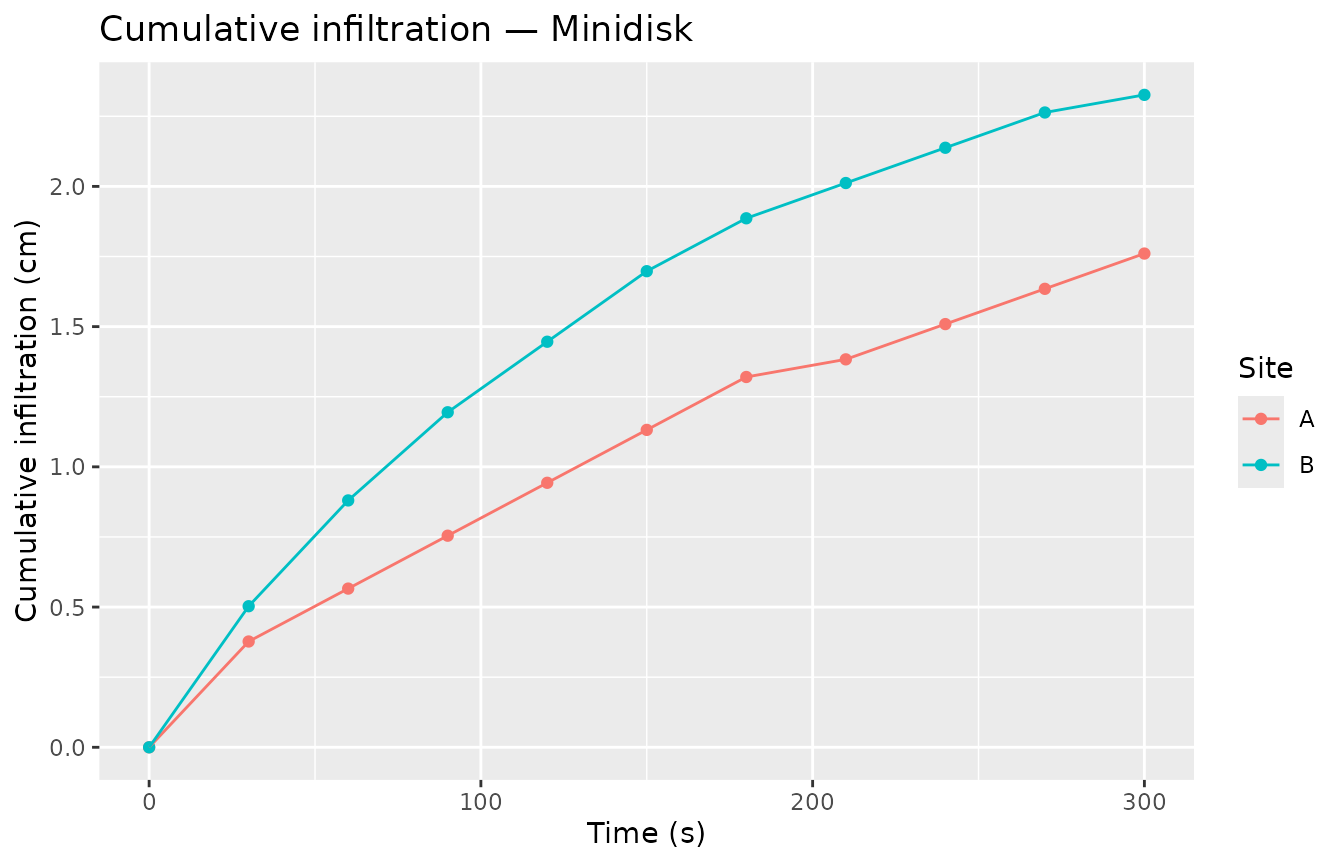
4. Visualisation
multi |>
  group_by(site) |>
  infiltration_cumulative(time = time, volume = volume) |>
  ggplot(aes(x = time, y = .infiltration, colour = site)) +
  geom_point() +
  geom_line() +
  labs(
    title  = "Cumulative infiltration — Minidisk",
    x      = "Time (s)",
    y      = "Cumulative infiltration (cm)",
    colour = "Site"
  )
References
Decagon Devices, Inc. (2005). Mini Disk Infiltrometer User’s Manual.
Philip, J. R. (1957). The theory of infiltration: 4. Sorptivity and algebraic infiltration equations. Soil Science, 84(3), 257–264.
Zhang, R. (1997). Determination of soil sorptivity and hydraulic conductivity from the disk infiltrometer. Soil Science Society of America Journal, 61(4), 1024–1030. https://doi.org/10.2136/sssaj1997.03615995006100060008x